Cyberattacks are increasing, and artificial intelligence is changing how threat actors operate. But is AI truly responsible for the rise in cyberattacks, or are we witnessing a broader transformation of the cybersecurity threat landscape?
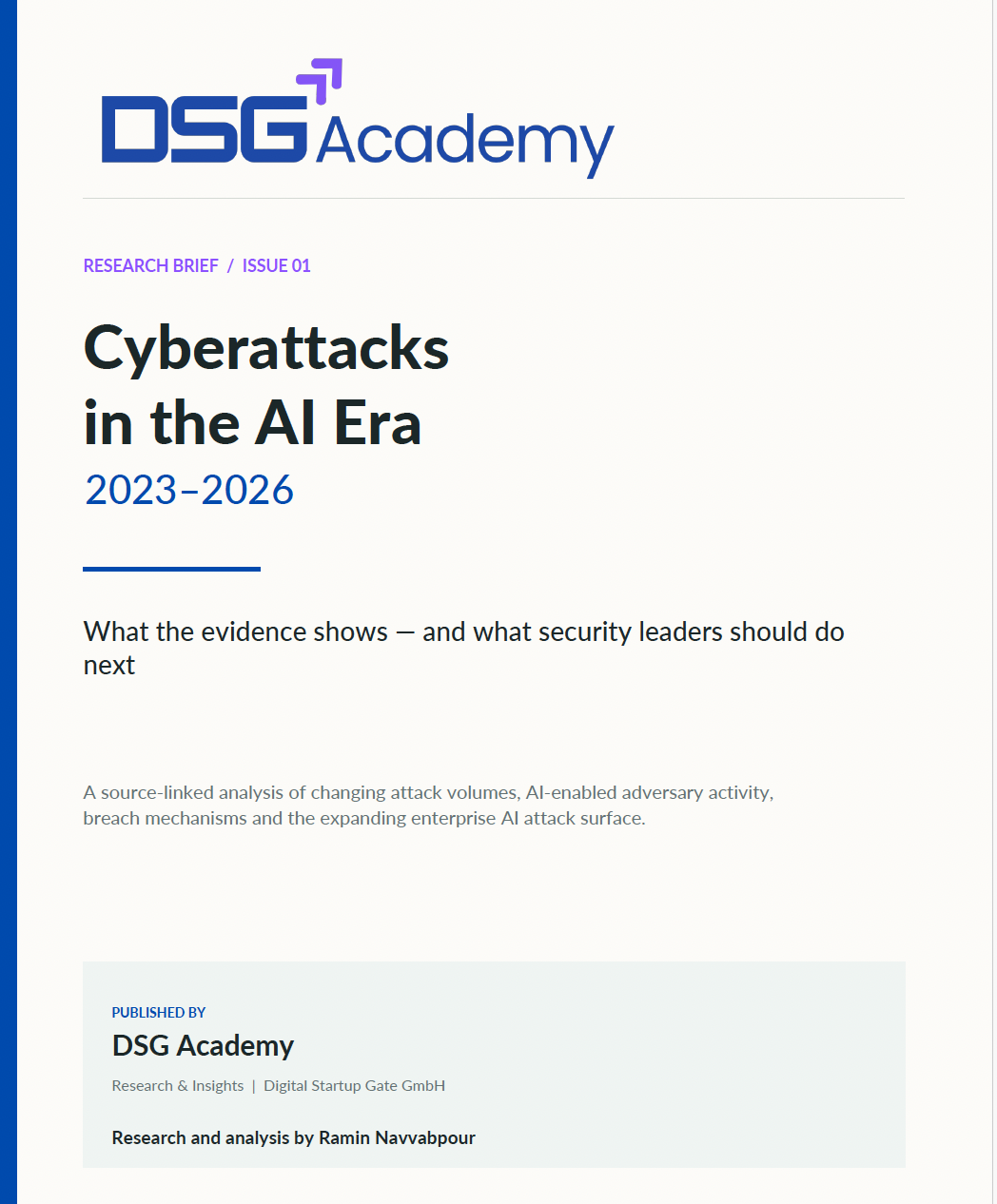
To explore this question, DSG Academy has published its first Research & Insights brief, Cyberattacks in the AI Era (2023–2026), researched and authored by Ramin Navvabpour.
This 10-page analytical report examines recent cybersecurity trends using findings from Check Point Research, CrowdStrike, Verizon, and the European Union Agency for Cybersecurity (ENISA).
Rather than attributing every increase in cyberattacks to artificial intelligence, the report distinguishes between observed threat activity, the growing capabilities of attackers, and the emerging security risks associated with enterprise AI adoption.
Cyberattacks Are Increasing — But What Do the Numbers Tell Us?
According to Check Point Research’s Cyber Security Report 2026, organizations experienced an average of 1,968 cyberattacks per week in 2025, representing an increase of approximately 70% compared with 2023.
Meanwhile, CrowdStrike’s 2026 Global Threat Report identified an 89% year-over-year increase in attacks by AI-enabled adversaries during 2025.
These findings are significant, but they measure different aspects of the threat landscape.
An increase in detected attacks does not automatically translate into an equivalent increase in successful breaches. Similarly, increased activity among AI-enabled adversaries does not establish that AI caused the overall growth in cyberattacks.
Understanding these distinctions is essential for making informed security investment and risk management decisions.
How AI Is Changing Cyber Threats
Artificial intelligence is becoming a force multiplier for existing cyberattack techniques.
Attackers can increasingly use AI to support reconnaissance, generate convincing social engineering content, automate repetitive activities, and accelerate parts of the attack lifecycle.
However, traditional security weaknesses remain critical.
The Verizon 2026 Data Breach Investigations Report identifies vulnerability exploitation as a leading initial access vector in its analysed breach dataset, demonstrating that familiar security challenges continue alongside emerging AI-related threats.
AI is changing the speed, scalability, and economics of cyberattacks — not necessarily replacing established attack methods.
A New Challenge: AI Systems as an Attack Surface
AI is not only a tool available to attackers. It also introduces new security and governance challenges within organizations.
As businesses deploy AI assistants and autonomous agents connected to corporate applications, sensitive data, and operational workflows, important questions emerge:
- What information can AI systems and agents access?
- Which actions can they execute through connected tools and APIs?
- How are permissions, human oversight, and accountability enforced?
- Can organizations detect and respond to prompt injection, unauthorized tool use, or AI-related data exposure?
Addressing these questions requires closer integration between traditional information security management and AI governance.
Frameworks such as ISO/IEC 27001 and ISO/IEC 42001 can provide complementary approaches for managing information security and AI-related risks within an integrated governance structure.
What Security and Risk Leaders Can Learn
The DSG Academy research brief goes beyond threat statistics to explore practical implications for CISOs, information security managers, GRC professionals, and AI governance leaders.
The report covers:
- Cyberattack trends from 2023 to 2026 and their measurement limitations.
- Changes in phishing, identity-based attacks, ransomware, and vulnerability exploitation.
- The evidence surrounding AI-enabled adversary activity.
- Emerging risks from AI agents, connected tools, and enterprise data access.
- How information security and AI governance can work together.
- A practical 90-day action plan to strengthen cyber resilience.
The report also identifies key management indicators for tracking exposure, identity security, AI access governance, and incident response readiness.
Download the Research Brief
Cyberattacks in the AI Era (2023–2026)
What the Evidence Shows — and What Security Leaders Should Do Next
Published by: DSG Academy | Research & Insights — Issue 01
Research & Analysis: Ramin Navvabpour
Publication: October 2026
Format: PDF | 10 pages | English
The report is available for free download.