Currently Empty: 0,00 €

A few months ago, “AI governance” was the kind of phrase that showed up in conference keynotes and got a polite nod. Something companies would “get to eventually.” That eventually just became now.
As of August 2026, the bulk of the EU AI Act is in force. Enforcement has started at both the national and EU level. High-risk AI systems, transparency obligations, the whole machinery — it’s live. If your company builds, buys, or simply uses AI tools (and let’s be honest, at this point almost everyone does), governance stopped being a nice-to-have and became a legal reality with real fines attached.
So let’s talk about what AI governance actually is, why the usual approach to compliance won’t cut it, and what a business can realistically do about it — without hiring an army of lawyers or grinding productivity to a halt.
What Is AI Governance, Really?
Strip away the jargon and AI governance is simply this: the set of rules, roles, and checks that make sure AI systems do what they’re supposed to do — safely, fairly, and accountably.
That means knowing:
- What AI systems your organization actually uses (yes, including the ones marketing quietly signed up for)
- What risk level each one carries
- Who is responsible when something goes wrong
- How decisions made by AI can be explained, challenged, or corrected
- Whether the data feeding these systems is handled lawfully
It sounds simple. In practice, most companies can’t answer the first question with confidence, let alone the rest.
Why Traditional GRC Frameworks Fall Short
Here’s the part a lot of consultants won’t say out loud: bolting AI onto an existing ISO 27001 or general risk management program doesn’t work. Traditional GRC was built around static systems — software that behaves the same way every time you run it. AI doesn’t play by those rules.
A model can drift. It can behave differently depending on the data it’s fed six months from now. It can produce a biased outcome nobody explicitly programmed. None of that fits neatly into a checklist designed for firewalls and access controls.
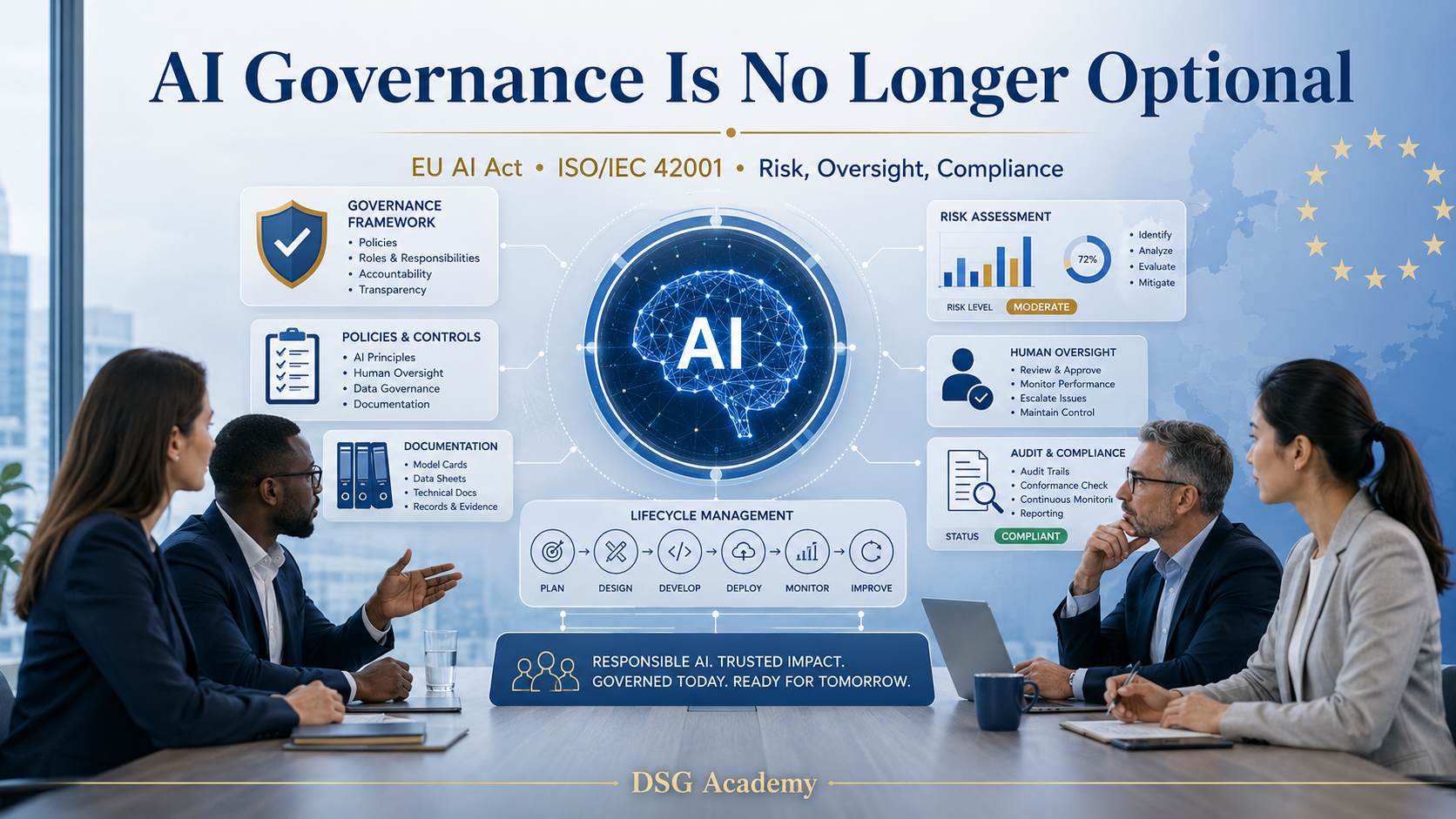
This is exactly why ISO/IEC 42001, the world’s first dedicated AI management system standard, exists. It doesn’t replace your information security governance — it sits alongside it, addressing the parts that ISO 27001 was never designed to cover: AI-specific risk assessment, lifecycle management, human oversight, and the ongoing monitoring an AI system needs long after it’s “approved.”
The EU AI Act, in Plain Language
You don’t need to read all 113 articles to understand the shape of it. Here’s the practical version:
Unacceptable-risk AI (social scoring, manipulative systems, certain biometric practices) — banned outright. This has applied since February 2025.
High-risk AI systems — think AI used in hiring, credit scoring, critical infrastructure, or education — now face strict requirements: risk management, documentation, human oversight, and conformity assessments. These obligations became enforceable this August.
General-purpose AI models (the GPT-style foundation models) — providers have had transparency and documentation duties since August 2025.
Everyone else — even if you’re not building high-risk systems, transparency rules mean people need to know when they’re interacting with AI, and AI-generated content often needs to be labeled as such.
The fines aren’t symbolic either — they scale similarly to GDPR, up to tens of millions of euros or a percentage of global turnover, depending on the violation.
What Good AI Governance Actually Looks Like
Forget the 40-page policy document nobody reads. A workable AI governance program has a few concrete pieces:
1. An AI inventory. You can’t govern what you don’t know exists. Map every AI tool in use across departments — including the “shadow AI” employees adopted on their own.
2. Risk classification. Sort each system by the EU AI Act’s risk tiers. This single step tells you where to focus 80% of your effort.
3. Clear ownership. Someone — not “the IT department” in the abstract, but a named person or committee — needs to own AI risk decisions.
4. Human oversight built in. Especially for anything touching hiring, credit, or safety. A human needs the ability to catch and override a bad AI decision before it causes harm.
5. Documentation that would survive an audit. Not because auditors are the point, but because if you can’t explain how a system makes decisions, you don’t actually control it.
6. Ongoing monitoring. AI governance isn’t a one-time certification. Models change, data changes, regulations change. Build in a review cycle rather than treating this as a box you tick once.
A Practical First Step: Gap Analysis, Not Panic
If your organization hasn’t started, the instinct is often to either freeze in place or throw money at the first consultant who mentions “compliance.” Neither helps.
The more useful first move is a structured gap analysis: where do you stand against ISO/IEC 42001 and the EU AI Act’s requirements today, and what’s the shortest realistic path to close the distance? This usually surfaces two or three priority actions rather than an overwhelming list of fifty — and that’s what makes it actually achievable.
Why This Matters Beyond Avoiding Fines
There’s a version of this conversation that’s only about risk avoidance, and that undersells the point. Companies with a genuine AI governance framework in place move faster, not slower. They can adopt new AI tools with confidence instead of second-guessing every deployment. They can answer a client’s due-diligence questionnaire in an afternoon instead of a week. And when something does go wrong with an AI system — and eventually, something will — they have a documented process instead of a scramble.
Governance, done right, isn’t the brake pedal. It’s what lets you drive faster with confidence that the car will actually stop when you need it to.
Where to Start
If you’re responsible for information security, compliance, or risk in your organization and AI governance still feels like an abstract future problem — it isn’t anymore. The regulatory clock has already started ticking, and the gap between “aware of the requirements” and “actually compliant” is where most of the risk lives.
At DSG Academy, we help organizations build AI governance frameworks grounded in ISO/IEC 42001 and aligned with the EU AI Act — through certified training for the people who’ll own this internally, and hands-on advisory for the frameworks themselves. Whether you need your team trained as ISO/IEC 42001 Lead Implementers or you need an outside pair of eyes to map where your AI risk actually sits, that’s the conversation worth having now, not after an audit forces it.
Curious where your organization stands? Get in touch with DSG Academy to talk through a gap assessment or explore our upcoming AI Governance training dates.